Building the Ultimate Home Defense Rifle: My Q Honey Badger Setup from Scratch
Dec 11, 2025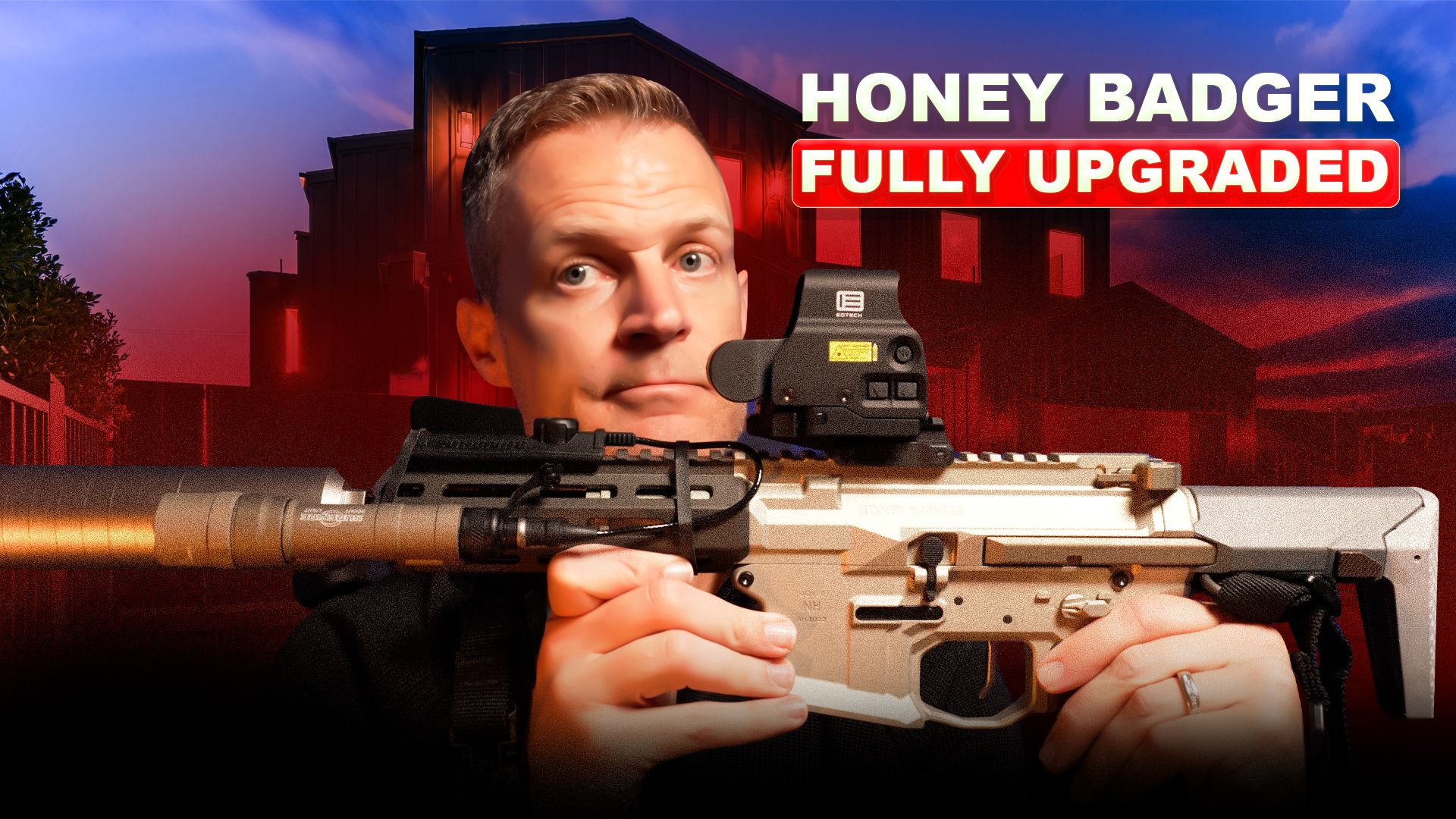
Hey, Dads. If you're anything like me—a guy juggling family life, faith, and the quiet (but very real) worry of keeping your loved ones safe at night—you've probably stared at your nightstand safe a time or two and thought, "Is this enough?" For years, my go-to was a trusty Glock 19 locked away next to the bed. It's reliable, compact, and gets the job done in a pinch. But as my family grew and the world felt a little less predictable, I started craving something with more reach, more control, and—honestly—less noise in the chaos of a midnight threat.
Enter the Q Honey Badger. This isn't just a rifle; it's a whisper-quiet guardian designed for the shadows of your hallway, not the open fields of a range day. In my latest video dropping today on the Home Defense playlist, I walk you through the entire build process: from unboxing this 7-inch .300 Blackout beast to decking it out with optics, lights, and a suppressor that turns thunder into a murmur. No expert here—just a dad sharing the sweat, the screw-ups, and the "aha" moments so you can skip the trial-and-error.
If you're new to this channel, welcome. We're all about becoming better protectors, providers, and patriarchs. We dive into crypto and finance on the Dad Ledger podcast (shoutout to my co-host Trent for the Honey Badger rec), prepper tips, and raw talks on faith and fatherhood. Stick around, and let's build something solid—starting with this rifle.
Watch the full video here: Q Honey Badger Home Defense Build – Step-by-Step Review (Pro tip: Use the timestamps below to jump straight to your pain points.)
Why the Q Honey Badger? A Dad's Upgrade Path
Let's back up. Why this rifle? Why now? It started with a late-night scroll through forums and a nudge from Trent during one of our podcast rants about financial freedom funding family security. The Honey Badger SPR (Short Barrel Rifle) in 7-inch .300 Blackout caught my eye for three big reasons:
- Compact Powerhouse: At just 4.5 pounds unloaded and under 20 inches collapsed, it's lighter than my toddler's backpack. Perfect for maneuvering tight corners in a 1,500-square-foot home without feeling like you're wrestling a broomstick.
- Subsonic Stealth: .300 Blackout is built for suppressed fire. Paired with a can, it drops decibels to hearing-safe levels—no earmuffs needed when seconds count. We're talking Hollywood-silencer quiet, but legal and effective.
- Versatility for Real Life: Subsonic rounds for quiet home defense; swap to supers for longer-range plinking. It's the Swiss Army knife of rifles for a guy who isn't running a full-time armory.
I saved up from side hustles (crypto dips taught me patience), budgeted like a boss, and pulled the trigger—literally. But stock? It's a solid base, not a finished product. Naked, it's loud, unlit, and unsighted. Time to accessorize.
In the video (starting at 3:53), I break down the "why" with raw honesty: This isn't about Rambo fantasies. It's about stacking the odds so you can focus on de-escalation, not disorientation. If an intruder breaches your door, you want control—light to blind, aim to neutralize, and silence to protect sleeping ears upstairs.
Step 1: The Foundation – Suppressor Install (The "Trash Panda" Magic)
First things first: Suppressors aren't toys. They're NFA items, meaning ATF paperwork, a $200 tax stamp, and a wait that tests your soul (mine took 8 months—I'll do a deep-dive video on that nightmare soon). But oh man, is it worth it.
The star? Q's "Trash Panda" suppressor. I unboxed it in a prior vid, but here's the install (video timestamp: 6:47). The Honey Badger ships with a "Cherry Bomb" muzzle device—a beefy, hand-tightening flash hider that ratchets on with reverse torque. It's genius: 25% harder to unscrew than to install, so it stays put through recoil.
- Tools Needed: None, really—just your hands and maybe gloves for grip.
- Process:
- Ensure the rifle's unloaded (more on safety in a sec).
- Thread the Cherry Bomb clockwise onto the barrel threads until finger-tight.
- Give it a firm twist—feel that satisfying lock.
- Slide the Trash Panda over the Cherry Bomb and clamp it down.
Boom. From ear-splitting crack to a polite thwup. In home defense, this means no permanent hearing loss for you or echoes waking the neighbors (or worse, alerting the threat to your position). Test it suppressed, and you'll wonder how you ever shot unsuppressed indoors.
Pro Dad Tip: Budget $800–$1,000 for a quality can. Skip the cheapies—they baffle more than they quiet.
Step 2: Optics – Raising the Sights for Real-World Eyes
Next up: Sighting in. The Honey Badger's low-profile rail begs for a riser, especially if you're not a chin-weld purist (video: 8:05). I grabbed a simple cantilever mount to lift my optic without adding bulk.
Enter the EOTech EXPS3 (or similar holographic—mine's the GSS model). Why holographic over red dot? Speed. That reticle pops in low light, and zeroing is a breeze at 50 yards. It's got a CR123 battery good for 1,000 hours, and the quick-detach lever means bed-to-range swaps in seconds.
- Install Steps (Timestamp: 9:50):
- Align the mount with the magwell for natural cheek weld—black anodizing lines up perfectly.
- Torque to spec (15–20 in-lbs; Google it, don't eyeball).
- Pop the optic on: Push the latch, slide forward, clamp down. Adjust side screws if needed for zero rock.
- Power on—hello, crisp red dot (not that "donut of death" some hate).
I haven't zeroed yet (range day next week—join me via vlog), but at a glance, it's aligned sweet. For night vision down the line? This pairs like peanut butter and jelly.
Mistake I Made: Over-tightening the riser first time—stripped a screw. Lesson: Snug now, torque later.
Step 3: Illumination – The Surefire Scout Light Setup (Lefty Edition)
As a lefty shooter, ergonomics aren't optional—they're survival. Flashlights aren't just for seeing; they're disorienters. In a dark house, a 1,000-lumen burst can buy you those critical seconds (video: 11:04).
My pick: Surefire Scout Light Pro. Compact (4 inches), rechargeable (USB-C to wall outlet—game-changer), and tailcap-activated for glove-friendly use. Mounted on the left rail (forward-most slot) to clear my sight picture.
- Mounting Hack (Timestamp: 12:18):
- Remove the Trash Panda first—avoids scratches on that sexy titanium finish.
- Use M-LOK washers/spacers to offset from the rail.
- Allen wrench in (1/16-inch size), thread forward. Finagle those washers—they're fiddly but essential for flush fit.
- Reinstall suppressor. Test: Button push floods the room without shadows killing your off-hand view.
Angle it 15–20 degrees up for hand wrap-around. Shadow on the wall? Minimal from my perspective. If you're right-handed, mirror this to the right rail.
Lefty Pro Tip: Forward mount clears your strong hand while keeping the beam parallel to bore. No more "oops, blinded myself" moments.
Step 4: Controls & Comfort – Tape Switch, Sling, and Hand Stop
Now, the finesse touches that turn a tool into an extension of your body.
- Tape Switch (Timestamp: 13:05): Surefire's pressure pad snaps onto the light's tailcap. Route the cable forward along the rail with zip ties or rubber bands (Warrior Poet extras FTW). Plug into the light—momentary on/off without breaking grip. I routed mine low to avoid snags on doorframes.
- Sling Setup (15:25): John Lovell's Warrior Poet Society two-point sling is buttery smooth—bungee for tension, QD swivels for quick don/doff. As a lefty, I mounted the forward QD as far front as possible. Rear on the stock's built-in point. Tension it snug but not sausage-tight; you want transition speed, not tourniquet vibes.
- Hand Stop (16:53): Q's polymer stop slots into the M-LOK for consistent finger placement. Mine was the wrong size (too long—sending back), but the concept? Gold. Prevents forward creep under stress, especially suppressed (that added length shifts balance).
Common Pitfall: Cross-threading M-LOK bolts. Go slow, feel the bite. And cable management? Zip ties over tape—less residue, more reusable.
The Full Build: Weight, Balance, and Bedroom Drills
Assembled, my Honey Badger tips the scales at 6.2 pounds loaded—feels like an extension, not a burden. Sling on, light flooded, optic zeroed (post-range update incoming), it's ready for dry-fire drills. I've been practicing bedroom-to-hallway transitions: Mag in, round chambered (visually/physically verified), finger indexed.
Safety first, always: Video starts with unloading (0:26)—mag out, bolt back, chamber poke, visual clear, bolt forward. Treat every rifle as hot, every time.
Total cost? $2,500-ish (rifle $1,800, suppressor $900, accessories $300). Worth every penny for peace of mind.
Home Defense Reality Check: Beyond the Build
This isn't gear porn; it's gap-filling. A suppressed, lit, slung rifle buys time—but pair it with:
- Training: Dry-fire weekly. Add a $20 blue gun for safe reps.
- Holster/Storage: Biometric safe by the bed—faster than combo locks.
- Family Plan: Drills with the wife and kids. "If you hear pops, go to the closet."
- Legal Know-Your-State: CCW? SBR stamps? Research, don't assume.
As men of faith, we're called to steward, not cower. Proverbs 24:11—"Rescue those being led away to death"—hits different when it's your door.
What's Next? Range Test, Battle Belt, and Your Input
Range day looms: Zeroing at 25/50 yards, subsonic groups, light drills. Battle belt build drops next—pouches, med kit, the works. We're prepping holistically here.
What about you? Wrong hand? Tight budget? Drop comments: "Ryan, add X accessory!" or "Lefty tips for Y?" Roast my rookie mistakes—I live for it.
If this resonates, hit subscribe. We're building a tribe of dads who provide, protect, and pray. Check my chat with Dr. John Deloney (Ramsey Solutions) on mental resilience—linked below. It's the soft skills behind the steel.
Stay vigilant, brothers. Your family's counting on you.